
The Shift
The Traditional Org Chart is Broken
For decades, managers have looked at their teams as a collection of human capabilities, organised by title and function. But quietly, over the last year, a new kind of team member has entered the picture — and most management frameworks have not caught up.
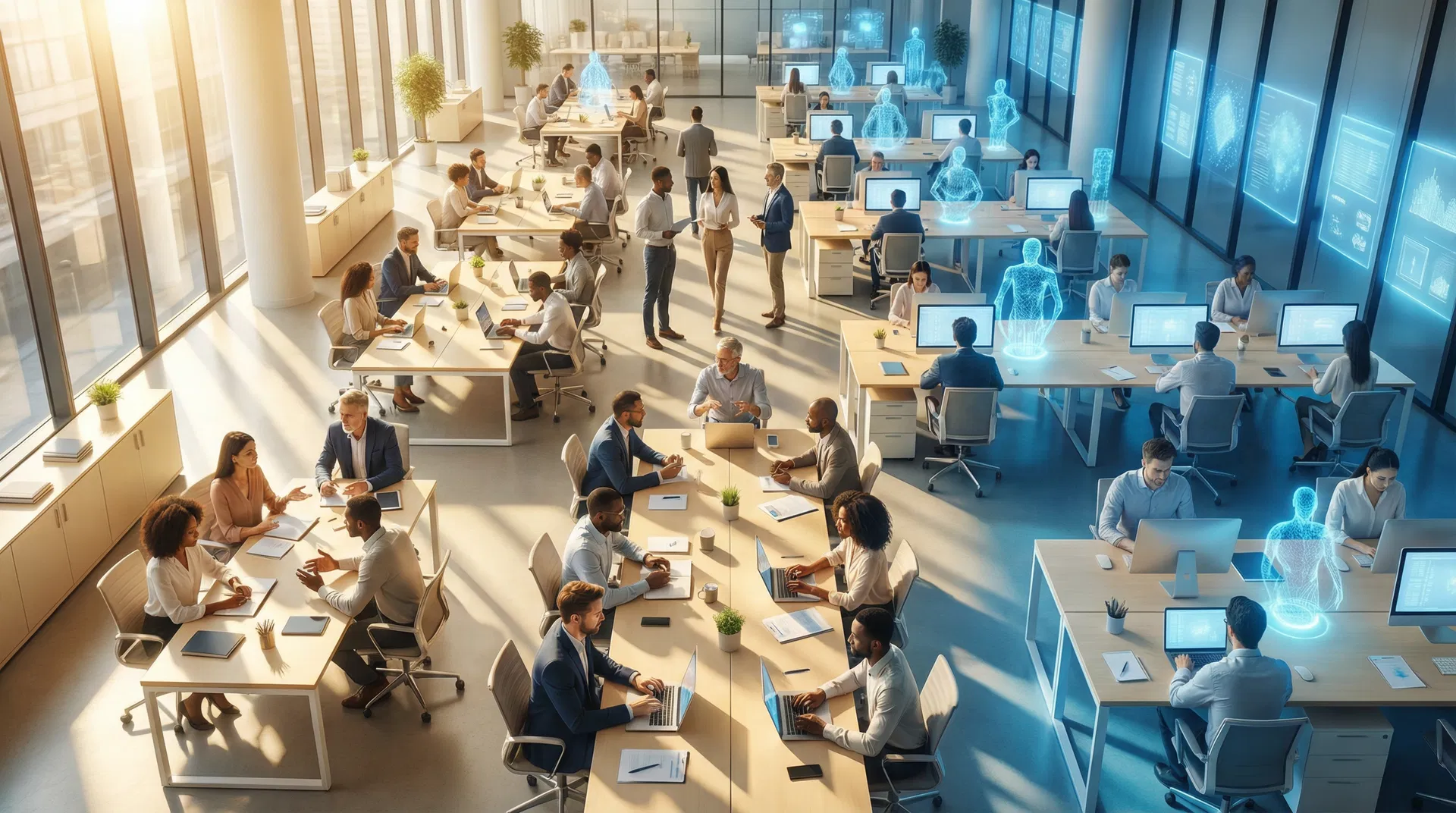
We are now managing mixed teams: humans and AI agents working in tandem, often on the same deliverable, sometimes in the same workflow.
This shift requires a fundamental rewiring of how we think about leadership. It is not just a technological upgrade. It is a profound psychological and operational challenge — and the managers who navigate it well will define what high-performance leadership looks like for the next decade.
Three angles on the same challenge
The Orchestrator
Core tension: Who decides what goes to AI vs. human, and how?
Best for: Strategic, operational audience
The Psychological
Core tension: How do you manage human anxiety in a team where AI is a peer?
Best for: Leadership, culture, EQ audience
The Accountability
Core tension: When AI makes a mistake, who owns it?
Best for: Risk, governance, management audience
From Delegation to Orchestration
The Manager Becomes an Orchestrator
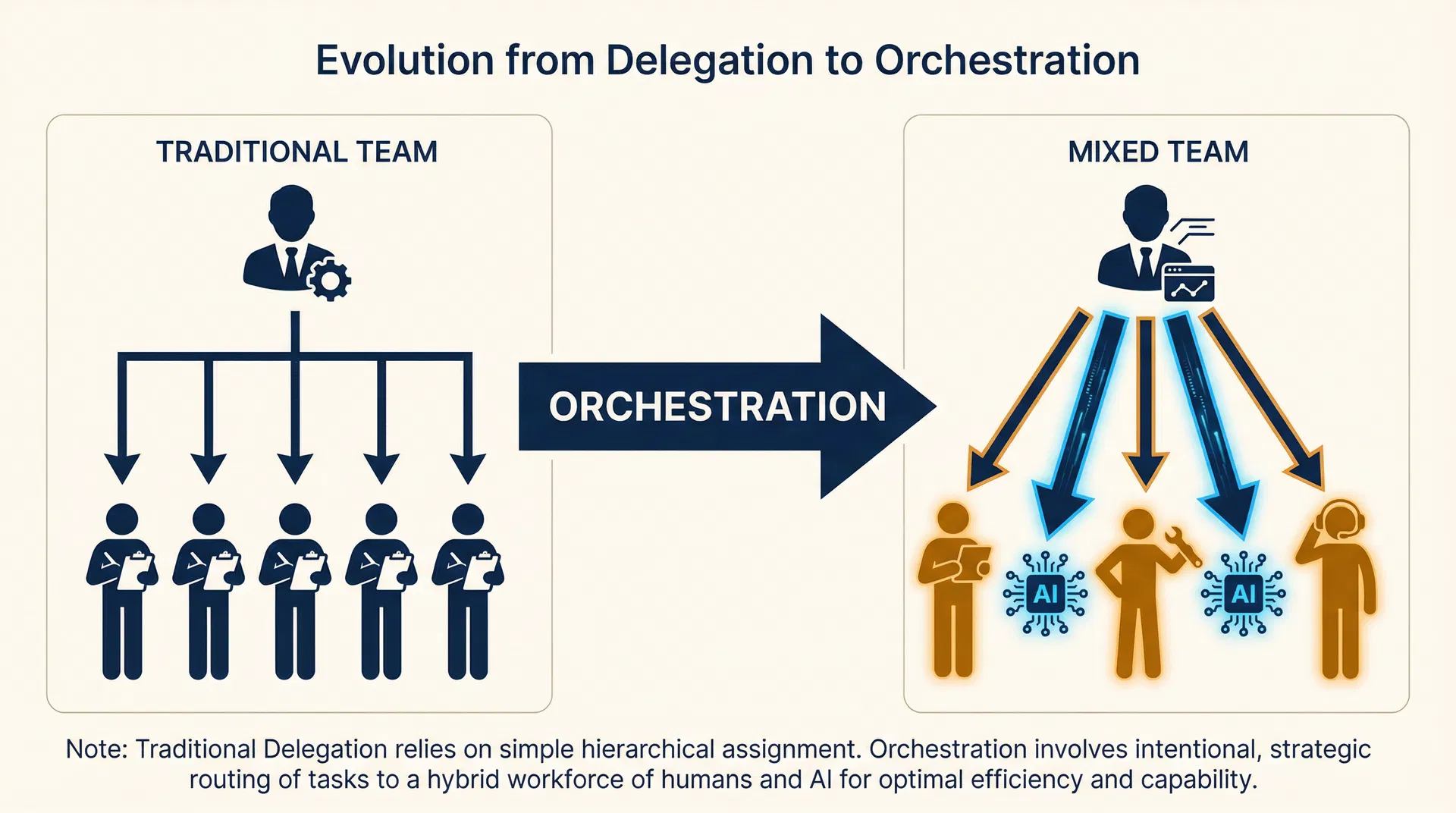
In a traditional team, a manager delegates tasks based on human bandwidth and skill. In a mixed team, the manager becomes an orchestrator. The core question changes from "Who has time to do this?" to "What is the nature of this task?"
AI excels at the predictable, the high-volume, and the structured. Humans excel at the ambiguous, the relational, and the strategic. The manager's job is to design workflows that integrate the two with intention.
If you are still treating AI as just a productivity tool rather than a functional part of your team's capacity, you are both underutilising it and missing the deeper organisational question it raises: what does your human team now exist to do?
This is not a small question. It touches job design, performance frameworks, career development, and team identity.
The Psychological Toll
The Hardest Part is Not the Technology
The hardest part of managing a mixed team is not the technology. It is the psychology.
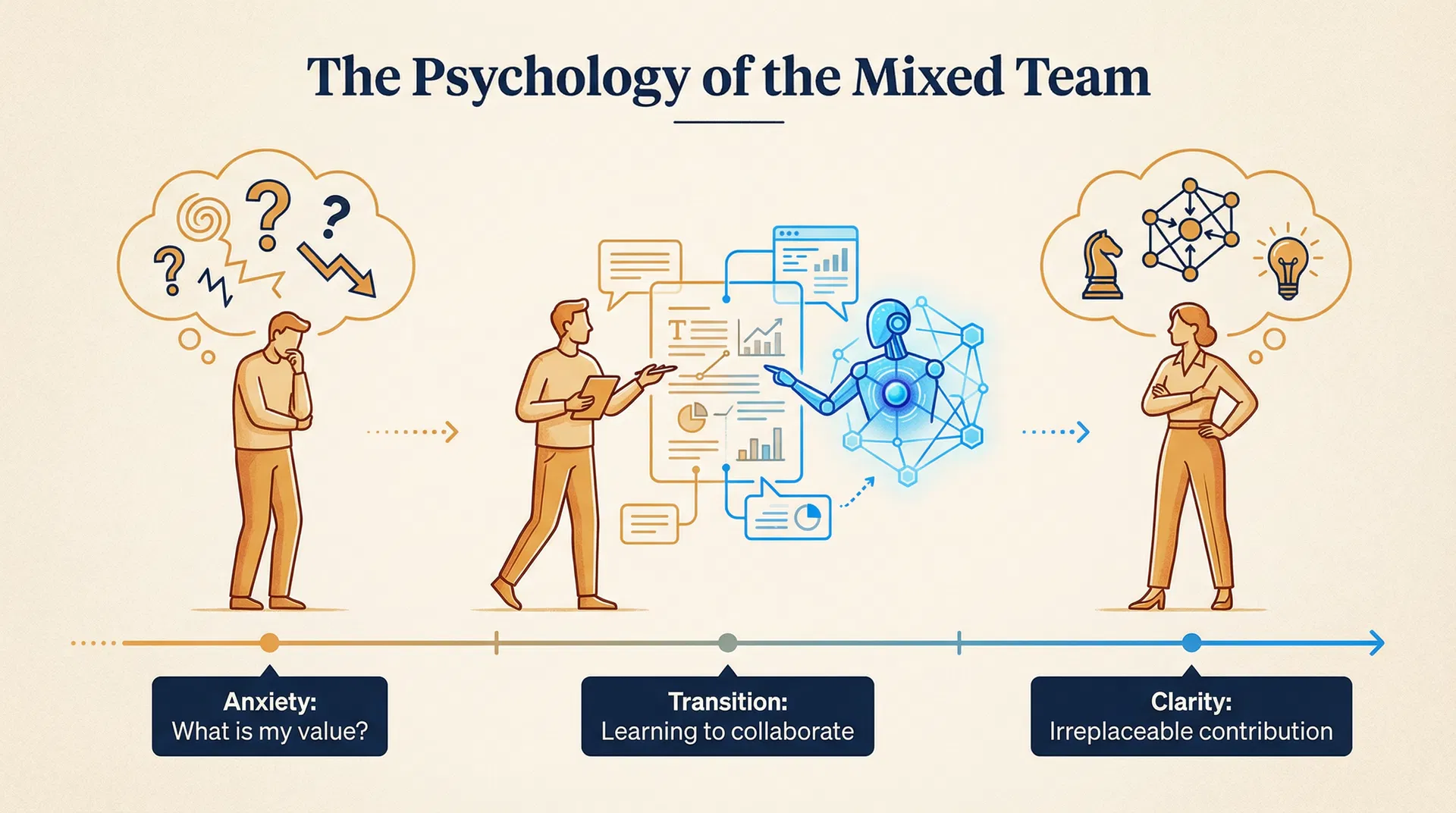
When an AI agent can draft a report in seconds that used to take a junior analyst three days, the human response is rarely pure excitement. It is often a quieter, more unsettling feeling: What is my value here? Am I being measured against the machine?
Great leaders in this new era must actively manage this anxiety. They must redefine what high performance looks like in a world where the baseline of productivity has been automated. Human value must now be measured differently — by the quality of questions asked, the ability to navigate complex stakeholder dynamics, the capacity for creative synthesis, and the judgment to know when the AI is wrong.
Building psychological safety in a mixed team means being explicit about this. Silence on this question does not reassure people. It amplifies their anxiety.
The Accountability Problem
When AI Makes a Mistake, Who Owns It?
There is also the question of accountability — and it is one that most organisations are not yet taking seriously enough.
When a human makes a mistake, we have established frameworks for feedback, correction, and growth. When an AI hallucinates a data point in a client presentation, or produces a flawed analysis that no one caught before it went out, who is responsible?
In a mixed team, the human is always the final editor and the ultimate backstop. But managing this requires a new kind of vigilance — training teams to think critically about AI output not just technically, but epistemically. To ask: Does this make sense? Does this align with what I know? What would I need to verify before I trust this?
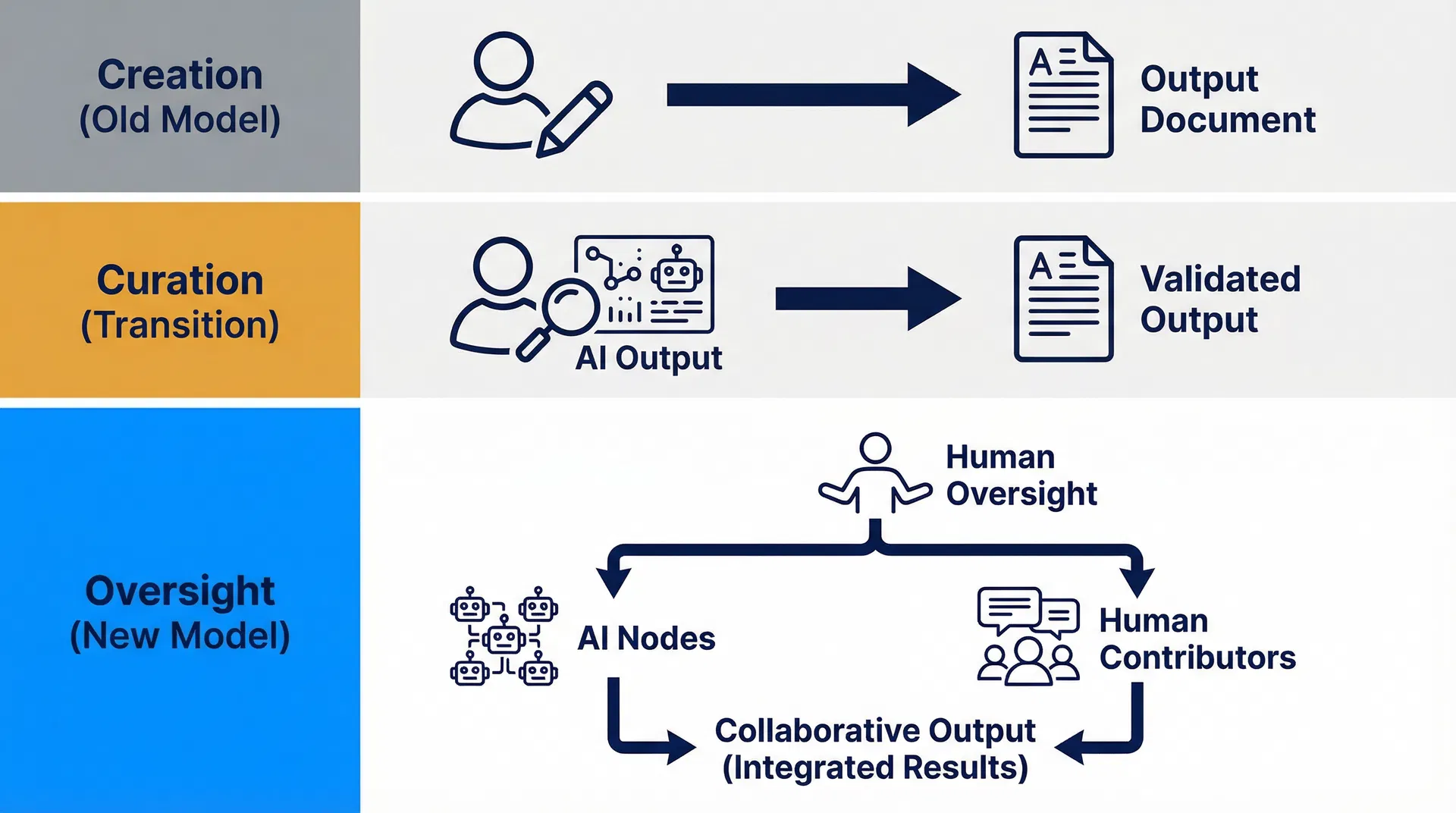
From producing output to reviewing and validating it
From reviewing individual outputs to designing the system that produces them
We are moving from a model of creation to a model of curation and oversight. That is a different cognitive skill, and it needs to be developed deliberately.
What This Means for the Manager
The Leaders Who Will Thrive
The best managers of the next decade will not necessarily be the most technically fluent. They will be the ones with the clearest thinking about how work gets done — and the emotional intelligence to hold a team together through a period of deep uncertainty about what work even means.
They will be the ones who can look at a complex project, break it into its component parts, assign the predictable to the machine, empower the human to do what only a human can do, and then build a culture where both are trusted, evaluated, and held accountable in ways that make sense.
The new leadership skill set
Workflow Design
Intentionally routing tasks between humans and AI
Psychological Safety
Holding space for anxiety while building clarity
Epistemic Oversight
Training teams to think critically about AI output
When the baseline of productivity is automated, how will you define — and defend — the irreplaceable value of your human team?
The org chart has changed. The question is whether your leadership has changed with it.
Self-Assessment
What Kind of Mixed-Team Leader Are You?
Answer five questions to discover your current leadership profile — and the one honest question you should be asking yourself next.